Beirut: Cliquot
Musikalischer Adventskalender 2023: USA (New Mexico) / Musical Advent Calendar 2023: 5. USA (New Mexico)
Der Song Cliquot der Band Beirut kontrastiert die Trauer einer Witwe mit einem Walzerryhthmus, der ihren Überlebenswillen dokumentiert. In der Tat hat die „Witwe Cliquot“ unter diesem Namen („Veuve Clicquot“) ein Champagner-Imperium begründet.
Podcast:
Cliquot
Todbringend hat sich aus dem Armenhaus*
ein Fieber zu meinem Liebsten geschlichen.
Nun muss die Trommel meinen Schmerz bezwingen,
mit tauben Fingern tromml‘ ich bis zum Tod.
Wüsst‘ ich nur eine Melodie,
um meinen Liebsten aufzuwecken!
Gäb‘ es nur einen Klang, der ihn
in meine Arme zurückbringen kann!
Brandschatzen will ich wie das Fieber!
Lieber alles zerstören als ihm gehören!
Funkelnd wie zerspringendes Glas
soll das Gewand meiner Liebe verbrennen.
Wüsst‘ ich nur eine Melodie,
um meinen Liebsten aufzuwecken!
Gäb‘ es nur einen Klang, der ihn
in meine Arme zurückbringen kann!
Von dunklen Brunnenschächten, sonnentrunknen Höhen,
vom letzten Rausch der Liebe will ich singen –
und von dem Schattenreich, das kommt,
den kalten Tagen, Liebster! ohne dich.
Beirut: Cliquot aus: The Flying Club Cup (2007) ein Song von Zach Condon und Owen Pallett
* wörtlich: Arbeitshaus. Gemeint sind die „working houses“, in denen mittellose Menschen einer im utilitaristischen Verständnis „vernünftigen“ Beschäftigung zugeführt werden sollten. Ursprünglich als Element der Armenfürsorge gedacht, entwickelten sich aus der Einrichtung später die „Zucht-Häuser“.
Von New Mexico zum Balkan: Die Entstehung der Band Beirut
Im Jahr 2002 entschloss sich Zach Condon zu einem radikalen Schritt: Mit nur 16 Jahren brach der aus Albuquerque im US-amerikanischen Neu-Mexiko stammende Musiker die Schule ab und begab sich auf eine Reise durch Europa.
Musikalisch haben ihn dabei vor allem seine Erfahrungen auf dem Balkan geprägt. Insbesondere die spezielle Art von Polka, die anarchische Art von Blasmusik und die Musikkultur der Sinti und Roma, die er dort kennengelernt hat, haben später auch sein eigenes musikalisches Schaffen beeinflusst.
Dies ist auch dem Song Cliquot anzuhören. Dieser entstammt dem Album The Flying Club Cup, das Condon 2007 mit der von ihm gegründeten, in wechselnden Besetzungen spielenden Band Beirut herausgebracht hat.
Bandname als Bekenntnis zu einem Crossover-Stil
Der Name der Band spiegelt Condons Bekenntnis zu einem Crossover-Stil wider, in dem verschiedene Musikstile zu einer neuen Einheit verbunden werden. Wie in der Stadt Beirut verschiedene religiöse und kulturelle Strömungen nebeneinander existieren und sich, allen Konflikten zum Trotz, gegenseitig befruchten, sieht er auch seine Songs als musikalische „melting-pots“ an.
Allerdings hat Condon den Bandnamen gewählt, ohne jemals in Beirut gewesen zu sein. Das erste Konzert der Band im Libanon fand erst 2014 anlässlich des Byblos International Festival statt.
Ob Condon sich einen anderen Namen für seine Band ausgesucht hätte, wenn er die Konflikte zwischen den religiösen und ethnischen Gruppen sowie die starken sozialen Disparitäten vor Ort erlebt hätte, bleibt fraglich. Entscheidend ist jedoch die Vorstellung, die Condon mit dem Namen verbindet. Für ihn ist Beirut schlicht „eine gute Analogie für meine Musik, […] ein Ort, an dem die Dinge aufeinanderprallen“.
Cliquot: ein musikalisches Denkmal für eine Witwe
Als Sänger fungiert in Cliquot der Violinist und Sänger Owen Pallett, der auch für die Geigenarrangements des Albums verantwortlich zeichnet. Der Song ist im Zusammenhang mit Condons Frankreicherfahrungen zu sehen, von denen auch die übrigen Stücke des Albums zeugen.
Condon bezieht sich in dem Lied auf das Schicksal von Barbe-Nicole Clicquot-Ponsardin (1777 – 1866). Diese hat als „veuve Clicquot“ (Witwe Clicquot) der gleichnamigen Champagner-Marke zu Weltruhm verholfen. Das Unternehmen mit Sitz in Reims in der Champagne hatte sie 1805 von ihrem verstorbenen Gatten, dem Sohn des Firmengründers, übernommen.
Der Song Cliquot kreist um die Gefühle der Witwe im Augenblick des Todes ihres Gatten. Alles in ihr ist in Aufruhr. In ihrer Verzweiflung träumt sie von Melodien, die den Verstorbenen von den Toten auferwecken könnten. Dann wieder schwört sie sich, so lange zu trommeln, bis sie selbst tot an seiner Seite niedersinkt. Oder sie gibt sich Zerstörungsphantasien hin, die dem „Fieber“, das ihrem Gatten, wie so vielen anderen, den Tod gebracht hat, jede Nahrung entziehen sollen.
Kontrapunktische Funktion des Walzerrhythmus
Der Walzerrhythmus, mit dem der Song unterlegt ist, erhält vor diesem Hintergrund eine kontrapunktische Funktion. Er gibt der im Text geäußerten Verzweiflung gewissermaßen einen produktiven Sinn, indem er das Erträumte – die Wiedervereinigung mit dem Verstorbenen – in eine imaginierte Realität überführt.
Der Walzer kann zwar das Schicksal nicht aufheben und das Geschehene nicht ungeschehen machen. Die tänzerische Ekstase, für die er steht, ermöglicht jedoch den vorübergehenden „Austritt“ aus dem Schicksal, einen kurzen Augenblick außerhalb der Zeit. Dieses euphorische „Carpe diem“ stellt der Song umso deutlicher der im Text zum Ausdruck gebrachten Trauer entgegen, als der Walzerrhythmus sich darin mit Anklängen an die lebensfrohe Balkan-Folklore vermischt.
Darin spiegelt sich zum einen die Erinnerung an das verlorene Glück wider, das in der Musik weiterlebt. Zum anderen deutet sich in der Musik aber auch der faktische Überlebenswille der trauernden Witwe an, die sich als legendäre Unternehmerin bereits zu Lebzeiten ihr eigenes Denkmal geschaffen hat.
Zitat übersetzt aus:
Syme, Rachel: Beirut: The Band. In: New York Magazine, 4. August 2006.

English Version
A Funeral Dirge to Waltz Rhythms
Beirut: Cliquot
The song Cliquot by the band Beirut contrasts the mourning of a widow with a waltz rhythm that documents her will to survive. In fact, the „Widow Cliquot“ founded a champagne empire under this name („Veuve Clicquot“).
Cliquot
A plague in the workhouse, a plague on the poor
Now I’ll beat on my drum ‚til I’m dead
Yesterday, a fever, tomorrow, St. Peter
I’ll beat on my drum until then.
But what melody will lead my lover from his bed?
What melody will see him in my arms again?
Set fire to foundation and burn out the station
You’ll never get nothing of mine
The pane of my window will flicker and billow
I won’t leave a stitching behind
But what melody will lead my lover from his bed?
What melody will see him in my arms again?
I’ll sing of the walls of the well and the house at the top of the hill
I’ll sing of the bottles of wine that we left on our old windowsill
I’ll sing of the years you will spend getting sadder and older
Oh love, and the cold, the oncoming cold
Beirut: Cliquot from: The Flying Club Cup (2007) a song by Zach Condon and Owen Pallett
St. Peter: probably refers to the forthcoming funeral.
workhouse: refers to the „working houses“, in which destitute people were to be given – according to a utilitarian understanding – „reasonable“ employment. Originally intended as an element of welfare for the poor, they later developed into penitentiaries.
From New Mexico to the Balkans: How the Band Beirut Came into Being
In 2002, Zach Condon decided to take a radical step: At the age of only 16, the musician from Albuquerque in New Mexico, USA, dropped out of school and embarked on a journey through Europe.
Musically, he was influenced above all by his experiences in the Balkans. Notably the special kind of polka, the anarchic kind of brass band music and the musical culture of the Sinti and Roma, which he got to know there, later inspired his own musical work.
This can also be heard in the song Cliquot. It appears on the album The Flying Club Cup, which Condon released in 2007 with his newly founded band Beirut.
A Band Name as a Commitment to a Crossover Style
The name of the band reflects Condon’s commitment to a crossover style, in which different musical styles are combined into a new unity. Just as different religious and cultural currents coexist in Beirut and, despite all conflicts, mutually inspire each other, he also sees his songs as musical „melting-pots“.
However, Condon chose the band name without ever having been to Beirut. The band’s first concert in Lebanon only took place in 2014 at the Byblos International Festival.
Whether Condon would have chosen a different name for his band if he had experienced the conflicts between the religious and ethnic groups as well as the strong social disparities on site remains questionable. What is decisive, however, is the idea that Condon associates with the name. For him, Beirut is simply „a good analogy for my music“, a „place where things collide“.
Cliquot: a Musical Memorial for a Widow
The song Cliquot is sung by Owen Pallett, who also created the violin arrangements for the album. The song is to be seen in the context of Condon’s experiences in France, of which the other pieces on the album also bear witness.
In the song, Condon refers to the fate of Barbe-Nicole Clicquot-Ponsardin (1777 – 1866). As „veuve Clicquot“ (Widow Clicquot), she made the eponymous champagne brand world-famous. She had taken over the company, based in Reims in the Champagne region, from her late husband, the son of the company founder, in 1805.
The song Cliquot revolves around the widow’s feelings at the moment of her husband’s death. Everything inside her is in turmoil. In her despair, she dreams of melodies that could raise the deceased from the dead. Then again she vows to keep drumming until she herself sinks down dead at his side. Or she indulges in fantasies of destruction to deprive the plague that has brought death to her husband, like to so many others, of any nourishment.
Contrapuntal Function of the Waltz Rhythm
Against this background, the waltz rhythm underpinning the song takes on a contrapuntal function. To a certain extent, it gives productive meaning to the despair expressed in the lyrics by transforming what is dreamed of – the reunion with the deceased – into an imagined reality.
It is true that the waltz cannot overrule fate and undo what has happened. However, the dance ecstasy it stands for allows a temporary „exit“ from fate, a brief moment outside of time. The song contrasts this euphoric „Carpe diem“ all the more clearly with the sadness expressed in the lyrics as the waltz rhythm is mixed with reminiscences of joyful Balkan folklore.
On the one hand, this reflects the memory of lost happiness, which lives on in the music. On the other hand, the music also hints at the will to survive of the grieving widow who, as a legendary entrepreneur, created her own monument during her lifetime.
Quotation taken from:
Syme, Rachel: Beirut: The Band. In: New York Magazine, 4. August 2006.
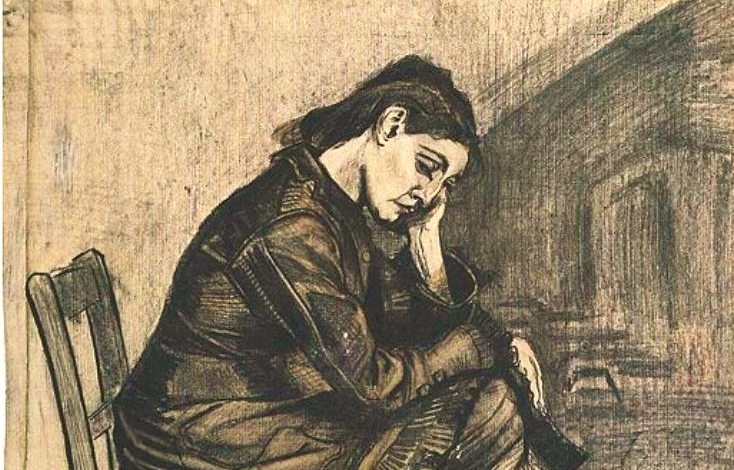
Bilder / Images: Vincent van Gogh (1853 – 1890): Trauernde Frau / Woman Mourning (1883); vangoghgallery.com / Wikimedia commons; Die Band Beirut bei einem Auftritt in der Great American Music Hall in San Francisco (links Zach Condon, mit Trompete) / The band Beirut performing at the Great American Music Hall in San Francisco (Zach Condon on the left, with trumpet); Wikimedia commons
Hintergrundmusik: Light_music: Memories returning (Pixabay)
 LiteraturPlanet